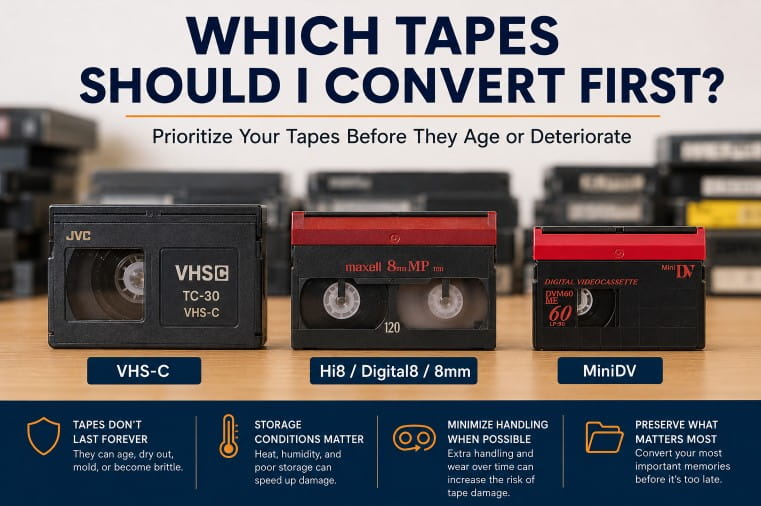
Which tapes should you convert first? If you have a box full of old tapes and only want to digitize some of them right now, it can be hard to know where to start.
The safest answer is to convert all of your tapes if possible. Old video tapes do not last forever. They can slowly degrade from age, heat, humidity, mold, poor storage, playback wear, and tape deterioration.
But if you need to prioritize, some tape formats and storage situations should move to the front of the line.
Convert All Your Tapes If You Can
If the tapes contain memories you care about, the best option is to digitize all of them sooner rather than later.
Old tapes store video and audio on magnetic tape. Over time, that tape can become unstable, sticky, moldy, brittle, stretched, or harder to play safely.
The tape may look fine from the outside, but the recording inside may already be aging.
Once a tape becomes too damaged, the video or audio may be difficult or impossible to fully recover. Digitizing your tapes now gives you the best chance of preserving what is on them while they are still playable.
If You Cannot Convert Everything, Start With the Most Fragile Tapes
If you have too many tapes to convert at once, start with the formats that are smaller, older, more delicate, or more likely to have playback problems.
As a general rule, smaller camcorder tapes should usually be prioritized because the tape inside is thinner, more compact, and more delicate than regular VHS.
That does not mean VHS tapes are safe forever. It simply means small camcorder tapes can sometimes become harder to play or repair because of their compact design.
1. MiniDV Tapes
MiniDV tapes should often be one of the first formats you convert.
MiniDV tapes are small digital camcorder tapes that were popular in the late 1990s and early 2000s. They are compact, delicate, and require working MiniDV playback equipment to transfer properly.
The biggest issue with MiniDV is not only the tape itself. It is also the equipment. Working MiniDV camcorders and decks are becoming harder to find. If the tape is still good but you no longer have a working camcorder, the footage becomes harder to access.
MiniDV tapes can also develop problems such as dropouts, playback glitches, tape damage, and equipment compatibility issues.
If you have MiniDV tapes with important family memories, digitizing them early is a smart move.
2. Hi8, Digital8, Video8, and 8mm Camcorder Tapes
Hi8, Digital8, Video8, and 8mm tapes should also be high on your priority list.
These formats use the same general cassette size, but the way the video was recorded can differ depending on the format and camcorder used. Customers often call these “camera tapes” or “camcorder tapes.”
These tapes are smaller than VHS and can be more delicate. They may also require the correct camcorder or playback device to transfer properly.
Common problems with 8mm-style camcorder tapes include:
- Jumpy video
- Tracking or playback problems
- Weak or missing audio
- Tape sticking or dragging
- Mold or humidity damage
- Playback equipment becoming harder to find
If you have Hi8, Digital8, Video8, or 8mm tapes, do not assume they are safe just because they are small and stored in a case. They should be converted before the tapes or equipment become harder to use.
3. VHS-C Tapes
VHS-C tapes are another format you should consider converting early.
VHS-C tapes are smaller camcorder tapes that were often used in family camcorders. They can be played using a compatible VHS-C camcorder or sometimes a VHS-C adapter with a VCR.
Because VHS-C tapes are compact, they can be more sensitive to mechanical issues than regular VHS. If the tape jams, breaks, or becomes damaged, it may need repair before transfer.
If your VHS-C tapes contain family memories, vacations, birthdays, holidays, or school events, it is better to digitize them before the tape or adapter becomes a problem.
4. VHS Tapes
VHS tapes are larger and can sometimes be more physically durable than smaller camcorder tapes. However, many VHS tapes are older and have been sitting in storage for decades.
A VHS tape recorded in the 1980s or 1990s may already be 30 to 40 years old. Even if VHS is larger than MiniDV or 8mm tapes, age still matters.
VHS tapes can suffer from:
- Mold
- Heat damage
- Humidity damage
- Tracking problems
- Weak audio
- Tape sticking or jamming
- Degraded picture quality
If your VHS tapes are old, moldy, damaged, or stored poorly, they should also be converted as soon as possible.
Storage Conditions Can Matter More Than Tape Format
The type of tape matters, but storage conditions can matter even more.
A VHS tape stored indoors in a cool, dry room may be in better condition than a MiniDV tape stored in a hot garage. On the other hand, a VHS tape stored in a damp basement may be in worse condition than a camcorder tape stored carefully in a closet.
Tapes should be prioritized if they were stored in:
- Garages
- Attics
- Basements
- Storage units
- Sheds
- Cars
- Damp or humid closets
- Hot or poorly ventilated rooms
Heat, humidity, mold, and seasonal temperature changes can speed up tape deterioration.
Convert Moldy or Damaged Tapes First
If any tape shows signs of mold, damage, or playback problems, move it to the top of your list.
Warning signs include:
- White, gray, or fuzzy spots on the tape
- A musty smell
- Broken or cracked cassette shells
- Ripped or pulled-out tape
- Tape that squeaks, sticks, or drags
- Playback with lines, jumping, distortion, or bad tracking
- Audio that cuts in and out
Do not keep playing a damaged or moldy tape over and over. Repeated playback can sometimes make the damage worse and may contaminate playback equipment.
Prioritize Tapes With the Most Important Memories
Technical risk is important, but emotional value matters too.
If you have to choose which tapes to convert first, start with the tapes that contain memories you cannot replace.
These may include:
- Weddings
- Birthdays
- Baby videos
- Family vacations
- School events
- Holidays
- Videos of loved ones who have passed away
- Business, legal, or historical footage
If a tape matters to your family, it should not wait at the bottom of the box.
Suggested Tape Conversion Priority List
If you need a simple order, start here:
- Moldy, broken, ripped, or damaged tapes
- MiniDV tapes
- Hi8, Digital8, Video8, and 8mm camcorder tapes
- VHS-C tapes
- Very old VHS tapes
- Any tape with irreplaceable family or business footage
This is only a general guide. The best choice depends on the condition, age, storage history, and importance of each tape.
What Format Should You Convert Tapes To?
For most customers, digital files such as MP4 are the most useful option.
Digital files are easy to:
- Watch on computers, phones, tablets, and smart TVs
- Save on USB drives or external hard drives
- Upload to cloud storage
- Share with family
- Back up in multiple places
DVDs can still be useful for customers who prefer physical discs, but digital files are usually better for long-term access and sharing.
How Quick Digitals Can Help
Quick Digitals helps customers convert old video tapes and camcorder tapes to digital files before the tapes continue to age.
We digitize formats such as VHS, VHS-C, Hi8, Digital8, Video8, 8mm, MiniDV, Betamax, camcorder tapes, and audio cassettes. We offer digital file options including USB, cloud download, and DVD.
If you have a mix of tape formats and are not sure which ones to convert first, we can help you identify the formats and prioritize the most at-risk tapes.
For customers near Glendale, Burbank, Pasadena, Los Angeles, and surrounding Southern California areas, local drop-off is available. For customers outside the area, nationwide mail-in service is available.
Don’t Wait Until the Tapes Stop Playing
Old tapes do not always fail all at once. They often decline slowly over time. By the time the damage becomes obvious, the recording may already be harder to recover.
If your tapes contain memories you care about, digitizing them now gives you the best chance of preserving the footage before more damage occurs.
Quick Digitals can help convert your tapes to digital files so they are easier to watch, save, share, and back up. Click here to get started.
And if you’ve ever wondered about the history of these magnetic tapes, you should read this post.