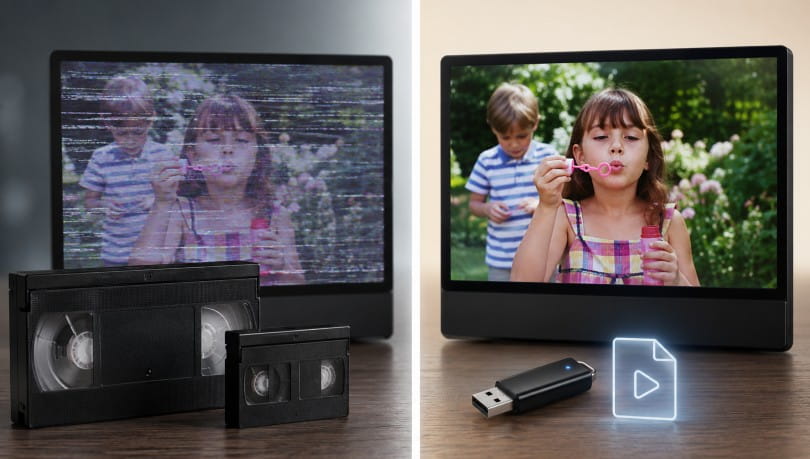
Cheap tape transfers can look bad when old tapes are rushed through basic equipment without enough attention to tracking, audio, tape condition, file quality, or playback problems.
At first, tape digitizing may seem simple: put the tape in a machine, press play, and record it to a digital file. But old video tapes are not always that easy. VHS, VHS-C, Hi8, Digital8, 8mm, MiniDV, Betamax, and audio cassettes can all have age-related problems that affect the final result.
If your tapes contain family memories, weddings, birthdays, vacations, school events, business footage, or recordings you cannot replace, the quality of the transfer matters.
Why Cheap Tape Transfers Can Look Bad
Cheap tape transfers often look bad because the process is rushed or handled with basic equipment. Old tapes are not always perfect, and they often need more care than a simple one-pass transfer.
A poor transfer can result in:
- Bad picture quality.
- Lines, jumping, or unstable tracking.
- Distorted colors.
- Weak, missing, or uneven audio.
- Over-compressed digital files.
- Parts of the tape being missed.
- Poor handling of damaged or aging tapes.
Sometimes the tape itself is the problem. But sometimes the tape has more quality available than the cheap transfer captured.
Old Tapes Often Need More Than One Attempt
One of the biggest differences between a rushed transfer and a careful transfer is how the tape is handled when there are problems.
Old tapes may have tracking issues, weak signal, bad audio, mold, stretching, or unstable sections. A cheap service may simply capture the tape once and move on, even if the picture jumps, the audio drops out, or the quality is poor.
With careful digitizing, problem tapes may need extra attention. Sometimes a tape plays better in one machine than another. Sometimes tracking needs to be adjusted. Sometimes the tape needs to be captured again to get a better result.
That is why experience matters.
Playback Equipment Makes a Big Difference
The equipment used to play the tape can have a major effect on the final digital file.
Old tapes need stable playback equipment. A worn-out VCR, dirty tape path, weak camcorder, or poor capture setup can make a tape look worse than it really is.
Playback problems can show up as:
- Tracking lines.
- Rolling or jumping picture.
- Flickering video.
- Distorted colors.
- Audio cutting in and out.
- Static or noise.
- A tape that stops or jams.
Some companies focus on speed and volume. But when the goal is preserving old memories, the playback setup matters.
Tracking Problems Can Ruin the Picture
Tracking is one of the most common issues with old VHS and camcorder tapes.
If the tracking is off, the picture may have lines, distortion, jumping, or unstable playback. A tape can look terrible if it is not played correctly, even if the recording itself is still recoverable.
Cheap tape transfers may not spend time adjusting playback or trying different equipment. The result can be a digital file that captures the problem instead of improving the playback.
A careful transfer gives the tape a better chance of looking as good as the source allows.
Audio Problems Are Easy to Miss
Video quality is important, but audio matters too.
Old tapes can have weak audio, missing channels, buzzing, muffled sound, or left/right channel problems. Some tapes may only play audio properly through certain equipment or settings.
A rushed transfer may not catch these issues until the customer notices later. By then, the tape may already be returned and the final file may not be as good as it could have been.
At Quick Digitals, audio quality is part of the transfer process. When possible, we work to preserve clear audio and avoid missing or weak channels.
Compression and File Quality Matter
The final digital file also matters. A tape can be captured from decent playback but still look bad if the digital file is compressed too heavily or exported with poor settings.
Over-compression can make old footage look blocky, blurry, or worse than necessary. Old tapes already have limited resolution compared to modern video, so poor encoding can make the result look even worse.
A good tape transfer should create a digital file that is practical, watchable, and easy to share without destroying the quality with unnecessary compression.
Damaged Tapes Need Careful Handling
Many old tapes have some type of damage or aging issue. This can include mold, heat damage, humidity damage, tape sticking, broken shells, weak audio, or unstable playback.
Cheap transfers may not be set up to deal with problem tapes. If the tape does not play smoothly, the service may give up, capture a poor version, or mark it as unplayable too quickly.
Careful handling is important because some tapes can still be digitized if the damage is not too severe.
That does not mean every damaged tape can be saved. But when the tape contains important memories, it is worth having it handled by someone who understands old tape formats and common playback problems.
This Applies to More Than VHS
Cheap tape transfers can affect many formats, not just VHS.
Old tape formats include:
- VHS
- VHS-C
- Hi8
- Digital8
- 8mm camcorder tapes
- MiniDV
- Betamax
- Audio cassettes
- Other magnetic tape formats
Customers often call small camcorder tapes “camera tapes,” but those tapes still need the right equipment and careful playback. A MiniDV tape, Hi8 tape, Digital8 tape, or VHS-C tape can look bad if it is transferred with the wrong setup or without enough attention.
Why In-House Digitizing Matters
When a company handles tapes in-house, there is more control over the process. The tapes are not simply passed off to an unknown third party or rushed through without attention.
In-house digitizing allows a service to inspect the tape, check the playback, watch for problems, and make adjustments when needed.
This is especially important for tapes with:
- Tracking issues.
- Mold or humidity damage.
- Heat damage.
- Weak audio.
- Long recordings.
- Old camcorder formats.
- Unstable playback.
For irreplaceable family memories, careful in-house work can make a big difference.
The Cheapest Option Is Not Always the Best Value
It is understandable to compare prices when choosing a tape transfer service. But the cheapest option is not always the best value if the final result looks bad, has missing audio, or fails to capture the tape properly.
Old tapes may only have one good chance left. If a tape is already fragile, moldy, damaged, or aging, a rushed transfer may not give it the attention it needs.
A better transfer is not just about making a file. It is about preserving the best version of the memory that can still be captured from the tape.
What to Look for in a Tape Transfer Service
Before choosing a company, look for more than just the lowest price.
A good tape digitizing service should offer:
- Clear pricing.
- Experience with multiple tape formats.
- Careful handling of old tapes.
- Good customer reviews.
- Options for USB, cloud download, or DVD.
- Clear communication.
- In-house digitizing when possible.
- A willingness to work with problem tapes carefully.
These details matter when the tapes contain memories that cannot be replaced.
How Quick Digitals Handles Tape Transfers
Quick Digitals has been digitizing tapes since 2014 and has helped customers preserve thousands of old tapes, camcorder videos, and family memories through careful in-house digitizing.
We handle formats such as VHS, VHS-C, Hi8, Digital8, 8mm, MiniDV, Betamax, camcorder tapes, and audio cassettes. We offer digital file options including USB, cloud download, and DVD.
We do not treat every tape like it is the same. Old tapes can have different problems, and some need more care than others. When possible, we work to get the best result the tape can provide.
For customers near Glendale, Burbank, Pasadena, Los Angeles, and surrounding Southern California areas, local drop-off is available. For customers outside the area, nationwide mail-in service is available. Once your tapes are converted, you’ll want to edit them. Check out our guide on the recommended video editing software.
Don’t Let a Cheap Transfer Ruin an Important Memory
Cheap tape transfers may seem like a good deal at first, but poor results can be disappointing when the tape contains something important.
If your tapes contain family memories, old home videos, business footage, school events, weddings, birthdays, or recordings of people you care about, the transfer should be handled carefully.
Once your tapes are digitized properly, you can save copies, share them with family, and protect the memories before the original tapes continue to age.
Quick Digitals can help you convert your old tapes to digital files with careful in-house digitizing. Click here to get started.