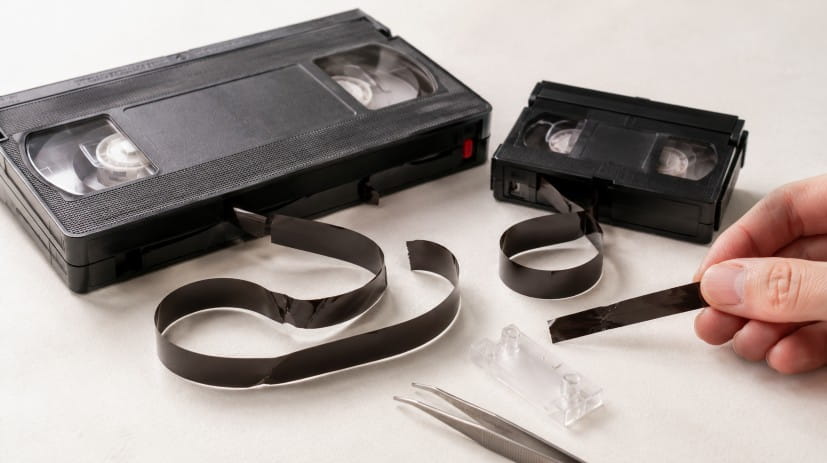
Ripped video tape does not always mean your memories are lost. If the tape inside a VHS, VHS-C, or other video cassette is ripped, snapped, pulled out, or damaged, it may still be possible to splice the tape and digitize it.
At Quick Digitals, we have spliced thousands of damaged tapes and were often able to transfer them after repair. In many cases, a broken tape can be fixed enough to play one more time so the video can be converted to a digital file.
The sooner the tape is handled properly, the better the chance of saving what is on it.
Can a Broken or Ripped Video Tape Be Digitized?
Yes, many broken or ripped video tapes can still be digitized if the damage is not too severe. The tape usually needs to be opened, repaired, spliced, and carefully tested before it can be transferred.
A ripped tape cannot simply be placed into a VCR or camcorder and played like normal. If the tape is snapped or pulled out, trying to force it to play can make the damage worse.
But if the tape is repairable, splicing can reconnect the broken section so the tape can move through playback equipment again.
What Is Tape Splicing?
Tape splicing is the process of repairing a broken section of tape by carefully reconnecting the two separated ends.
When the tape inside the cassette breaks, the video cannot play correctly because the tape path is interrupted. A splice can reconnect the tape enough to allow playback and digitizing.
The goal is not to make the tape brand new. The goal is to repair it carefully enough to capture the video before the tape deteriorates further.
Common Tape Problems That May Need Splicing
Video tapes can break or rip in several ways. Sometimes the damage happens because the tape is old. Other times it happens when a VCR or camcorder eats the tape, pulls it out, or jams.
Common problems include:
- The tape is snapped in half.
- The tape is ripped or torn.
- The tape was pulled out of the cassette shell.
- The tape got stuck inside a VCR or camcorder.
- The tape is tangled inside the cassette.
- The cassette shell is damaged.
- The tape does not rewind or fast-forward correctly.
- The tape plays for a short time and then stops.
If your tape has one of these problems, do not keep trying to play it. The safest step is to have it inspected before more damage happens.
Which Tapes Are Easier to Splice?
Some tape formats are easier to splice than others.
In general, VHS and VHS-C tapes are usually the easiest video tapes to splice. They are larger than many camcorder formats, and the tape is easier to access and repair compared to very small tape formats.
Formats that are usually easier to splice include:
- VHS tapes
- VHS-C camcorder tapes
These are the most common broken tape repairs we handle. If the tape is not badly damaged, there is often a good chance it can be repaired enough to digitize.
Which Tapes Are More Difficult to Splice?
Some smaller tape formats are more difficult because the tape is thinner, smaller, and more delicate.
More difficult formats may include:
- Hi8 tapes
- Digital8 tapes
- 8mm camcorder tapes
- MiniDV tapes
These tapes may still be repairable in some cases, but they are more delicate than VHS and VHS-C. The repair depends on where the break is, how badly the tape is damaged, and whether the tape can still move safely through playback equipment.
MiniDV, Hi8, Digital8, and 8mm camcorder tapes are smaller and more sensitive, so they need extra care.
Audio Cassettes Can Be Extremely Difficult
Audio cassettes can sometimes be very difficult to splice, depending on the damage and the condition of the tape.
The tape inside an audio cassette is very thin and narrow. If it is tangled, stretched, brittle, or broken in a bad location, repair can be challenging.
Some audio cassette repairs may be possible, but they are not always as straightforward as VHS or VHS-C repairs.
How Much Does Tape Splicing Cost?
At Quick Digitals, tape splicing costs $15 per tape when a tape needs repair before it can be digitized.
This is in addition to the normal digitizing cost.
Our standard video tape digitizing price is $20 per tape.
So if a tape needs splicing and digitizing, the total is usually:
- $15 for tape splicing
- $20 for tape digitizing
- $35 total for a tape that needs splicing and transfer
If the tape does not need splicing, then the normal transfer price applies.
Should You Try to Fix a Broken Tape Yourself?
It is usually better not to try fixing an important tape yourself unless you know what you are doing.
A broken tape can be delicate. If you pull too hard, use the wrong tape, touch the wrong area, or force the cassette closed, you can make the damage worse.
Common DIY mistakes include:
- Using regular household tape on the wrong part of the tape.
- Touching or bending the magnetic tape surface.
- Pulling more tape out of the cassette shell.
- Misaligning the tape path.
- Trying to play the tape before it is repaired properly.
- Breaking the cassette shell tabs or internal parts.
If the tape contains memories you care about, it is safer to have it repaired and digitized carefully.
Can the Broken Section Be Saved?
When a tape is spliced, the exact damaged section may not always be recoverable.
If the tape is physically ripped, torn, or missing material, the footage at the damaged spot may have a small glitch, jump, or missing section. However, the rest of the tape may still be saved.
For many customers, losing a few seconds around the damaged area is much better than losing the entire tape.
The goal is to repair the tape enough to capture as much of the recording as possible.
What If the VCR Ate the Tape?
If a VCR or camcorder ate the tape, do not keep pulling on it. Pulling the tape can stretch it, rip it, wrinkle it, or break more of the recording.
If part of the tape is still stuck in the machine, remove it carefully if possible. If you are not comfortable doing that, stop and get help before the tape is damaged further.
A tape that was eaten by a VCR may still be repairable, especially if the tape is not badly stretched or shredded.
What If the Cassette Shell Is Broken?
Sometimes the tape itself is not the only problem. The plastic cassette shell may also be cracked, broken, or jammed.
In some cases, the tape may need to be moved into another shell or repaired so it can move properly during playback. This depends on the format and the condition of the cassette.
A damaged shell can prevent the tape from playing even if the magnetic tape inside is still usable.
Why Digitizing After Repair Matters
Once a broken tape has been repaired, it should be digitized as soon as possible.
A splice is usually meant to help the tape play again so the content can be captured. It does not make the tape new again, and it does not stop the rest of the tape from aging.
After digitizing, you can save the video as a digital file and back it up on a USB drive, computer, external hard drive, or cloud storage.
This protects the memory even if the original tape continues to deteriorate later.
How Quick Digitals Can Help
Quick Digitals has been digitizing tapes since 2014 and has repaired and spliced thousands of tapes before transferring them to digital files.
We can often splice and digitize broken or ripped video tapes, especially VHS and VHS-C tapes. We also handle many other formats, including Hi8, Digital8, 8mm, MiniDV, Betamax, camcorder tapes, and audio cassettes.
Some formats are more difficult than others, and not every damaged tape can be saved. But if the tape is repairable, we can often fix it enough to digitize the footage.
For customers near Glendale, Burbank, Pasadena, Los Angeles, and surrounding Southern California areas, local drop-off is available. For customers outside the area, nationwide mail-in service is available.
Don’t Throw Away a Broken Tape
A broken or ripped video tape may still have recoverable memories on it. Even if the tape looks bad, it may be possible to splice it and transfer the footage.
If your tape is snapped, ripped, tangled, pulled out, or damaged, do not keep trying to play it. The safest move is to have it checked before the damage gets worse.
Quick Digitals can help repair and digitize many broken tapes so your memories can be preserved as digital files. Click here to get started.