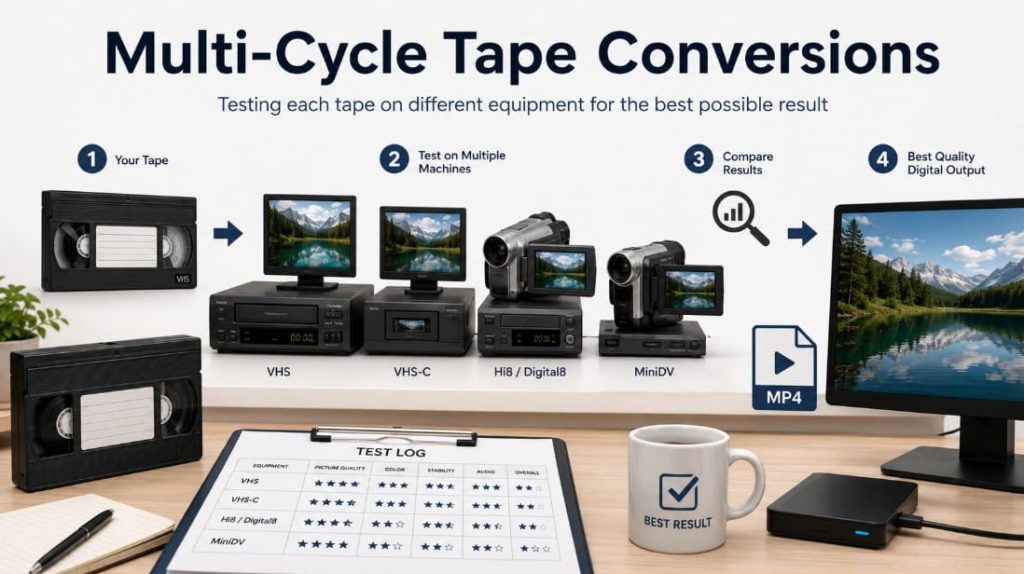
Multi-cycle tape conversions are part of the careful digitizing process we use at Quick Digitals to get the best possible result from old video tapes and audio cassettes.
As tapes age, they do not always play the same way on every machine. A VHS tape, VHS-C tape, Hi8 tape, Digital8 tape, 8mm tape, MiniDV tape, Betamax tape, or audio cassette may look or sound bad on one piece of equipment but play much better on another.
That is why we do not treat every tape like it is the same. When needed, we test tapes on different playback equipment to find the best available video and audio quality before digitizing.
What Does Multi-Cycle Tape Conversion Mean?
Multi-cycle tape conversion means testing an old tape through more than one playback setup when needed, instead of accepting the first result from a single machine.
For example, if a customer brings in five tapes, all five tapes may not play perfectly on the same equipment. One tape may play better on one VCR, while another tape may have better audio or less jumping on a different machine.
Old tapes can be unpredictable. A tape that looks bad on one player may look cleaner, more stable, or sound better on another.
At Quick Digitals, multi-cycle conversion is our way of giving each tape a better chance of being captured properly.
Why Old Tapes Play Differently on Different Equipment
Video tapes and audio cassettes are magnetic media. They age over time, and the condition of the tape can affect how well it plays.
Different machines have different video heads, tape paths, tracking behavior, audio playback quality, and mechanical condition. Because of that, the same tape can produce different results depending on the equipment used.
A tape may have problems such as:
- Jumpy video.
- Tracking lines.
- Weak or missing audio.
- Flickering picture.
- Distorted colors.
- Sections that play better on one machine than another.
- Audio that sounds cleaner on different equipment.
- Playback that stops, drags, or becomes unstable.
When this happens, using only one machine may not give the best result.
Cheap Tape Transfers Often Use One Playback Setup
Some cheap tape transfer services may use the same playback setup for every tape. If the tape looks bad, sounds bad, or plays with tracking problems, the customer may simply receive that poor result.
The problem is that the bad result may not always be the best the tape can do. Sometimes the tape needs to be tested on different equipment to find a cleaner playback.
This is one reason cheap tape transfers can sometimes look bad. The service may be focused on speed instead of finding the best possible playback for each tape.
Old family tapes deserve more care than a rushed one-machine transfer.
How Quick Digitals Handles Multi-Cycle Conversions
At Quick Digitals, we do not simply accept a bad result if a tape may be able to play better. When needed, we test tapes on different playback equipment to find the best available result.
This may include checking for:
- Better picture stability.
- Less jumping or distortion.
- Improved tracking.
- Cleaner audio.
- Better playback through different machines.
- Fewer dropouts or playback issues.
Once we find the best playback option for the tape, we digitize it from that setup.
This process takes more effort, but it can make a big difference for old tapes that do not play well on the first try.
Multi-Cycle Conversions Are Included Free
At Quick Digitals, multi-cycle conversions are included at no additional charge when needed.
Our standard video tape digitizing price is $20 per tape, and we do not charge extra just because a tape needs additional playback testing to get a better result.
This is important because many old tapes are not perfect. Customers should not be punished with extra fees just because their tapes need care.
When a tape needs extra attention, we do our best to find the best available playback before creating the digital file.
What Problems Can Multi-Cycle Conversion Help With?
Multi-cycle conversion can help when a tape plays poorly on one machine but better on another.
It may help with issues such as:
- Jumpy video.
- Tracking problems.
- Rolling or unstable picture.
- Weak audio.
- Missing left or right audio channels.
- Color instability.
- Video dropouts.
- Tapes that play better on certain equipment.
It does not mean every damaged tape can be made perfect. If the tape itself is badly damaged, moldy, shedding, broken, or missing recorded information, there may be limits to what can be recovered.
But when the issue is playback compatibility or equipment sensitivity, testing different machines can sometimes improve the final result.
This Applies to More Than VHS Tapes
Multi-cycle tape conversions are not only for VHS tapes. Different formats can all play differently depending on the equipment used.
This can apply to formats such as:
- VHS
- VHS-C
- Hi8
- Digital8
- 8mm camcorder tapes
- MiniDV
- Betamax
- Audio cassettes
- Other magnetic tape formats
Customers often call smaller formats “camera tapes,” but each format has its own playback requirements. A tape may need the right camcorder, deck, adapter, or playback equipment to get the best result.
Why One Tape Order Can Need Multiple Machines
It is common for a customer to bring in several tapes from the same family collection. Even when the tapes look similar, they may not all behave the same way.
One tape may have been recorded on a different camcorder. Another may have been stored in a hotter area. Another may have tracking issues. Another may have weak audio. Another may have aged better than the rest.
Because of this, a single order can require different playback equipment for different tapes.
That is why multi-cycle conversions matter. The goal is not to force every tape through the same machine. The goal is to find the best available result for each individual tape.
The Final Digital File Depends on the Playback Source
A digital transfer is only as good as the playback used to capture it.
If the tape is played on poor equipment or the wrong machine for that tape, the final digital file may show the same problems: jumping, lines, weak audio, unstable picture, or bad tracking.
Once a bad transfer is made, the file may not represent the best version of the tape. That is why the playback step matters so much.
Multi-cycle conversion helps improve the chance that the digital file is created from the best playback source available for that tape.
Why Experience Matters
Old tapes are not always predictable. Sometimes the problem is the tape. Sometimes the problem is the machine. Sometimes the tape needs a different playback path to produce a better result.
Since 2014, Quick Digitals has worked with many different tape formats and many different tape conditions. We have seen tapes that looked bad on one machine but played better on another.
That experience helps us know when a tape may need another attempt instead of simply accepting the first playback result.
How Quick Digitals Can Help
Quick Digitals provides careful in-house tape digitizing for customers who want their old tapes converted to digital files.
We digitize formats such as VHS, VHS-C, Hi8, Digital8, 8mm, MiniDV, Betamax, camcorder tapes, and audio cassettes. We offer digital file options including USB, cloud download, and DVD.
When needed, our multi-cycle conversion process helps us test tapes on different playback equipment to find the best available video and audio result before digitizing.
For customers near Glendale, Burbank, Pasadena, Los Angeles, and surrounding Southern California areas, local drop-off is available. For customers outside the area, nationwide mail-in service is available.
Better Playback Can Mean Better Memories
Old tapes may only have one good transfer left. If the first playback looks bad, that does not always mean the tape is hopeless. It may need to be tested on different equipment.
Multi-cycle tape conversions give each tape a better chance of being captured from the best available playback source.
At Quick Digitals, this extra care is included free when needed because preserving your memories properly matters. Click here to get started.