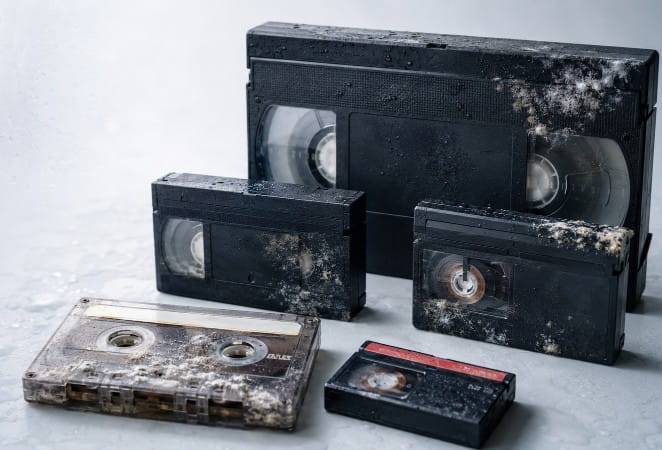
Tape mold is one of the biggest risks to old video tapes and audio cassettes, especially when they have been stored for years in humid areas. VHS, VHS-C, Hi8, Digital8, 8mm, MiniDV, Betamax, and audio cassettes can all be affected by moisture, mold, and tape deterioration.
One of the biggest threats to old tapes is humidity.
The National Archives notes that higher humidity can contribute to mold growth on magnetic media, which is why old tapes should be stored carefully and digitized before serious deterioration occurs. Learn more from the National Archives.
Moisture in the air can create the perfect environment for mold, mildew, tape deterioration, and playback problems. This can affect many types of tapes, including VHS, VHS-C, Hi8, Digital8, 8mm, MiniDV, Betamax, and audio cassettes.
If your tapes contain family memories, weddings, birthdays, vacations, school events, business footage, or old recordings you cannot replace, it is important to digitize them before the damage becomes permanent.
Why Humidity Is Dangerous for Old Tapes
Video tapes and audio cassettes are made with thin magnetic tape wound inside a plastic shell or cassette. Over time, humidity can affect the tape, the tape coating, the internal parts, and the way the tape moves during playback.
When tapes are stored in humid conditions, several problems can happen:
- Mold can grow on the tape surface.
- The tape can become sticky or unstable.
- The magnetic coating can begin to shed or flake.
- The tape can become harder to play safely.
- Audio and video quality can get worse.
- In severe cases, the tape may no longer be recoverable.
This is why waiting too long can be risky. A tape may look normal from the outside, but the actual tape inside may already be damaged.
Mold Can Permanently Damage Video Tapes and Audio Cassettes
Mold is one of the most serious problems we see with old tapes.
Once mold begins growing on a tape, it can spread across the tape surface and inside the cassette shell. During playback, that mold can also contaminate equipment, which is why moldy tapes need to be handled carefully.
The problem is not just that mold looks bad. Mold and moisture can affect the tape coating itself. The black magnetic layer on the tape is where the video and audio information is stored. If that layer starts shedding, flaking, or coming apart, there may be no way to fully recover the recording.
At that point, the issue is no longer just “poor quality.” The actual recorded material may be physically damaged.
That is why digitizing early matters.
Humid States Can Be Especially Hard on Old Tapes
Tape damage can happen anywhere, but humidity makes the risk much higher.
This is especially important for people living in humid states such as:
- Florida
- Louisiana
- Mississippi
- Alabama
- Georgia
In these areas, tapes stored in garages, closets, basements, attics, sheds, and storage units may be exposed to moisture for years. Even if the tapes were stored indoors, long-term humidity can still create problems over time.
Many people do not realize there is a problem until they finally try to play a tape and see distortion, lines, bad audio, tracking issues, or the tape will not play correctly.
By then, some of the damage may already be permanent.
This Applies to More Than Just VHS Tapes
A lot of people think tape damage only applies to VHS tapes, but that is not true.
Humidity and mold can affect many tape formats, including:
- VHS
- VHS-C
- Hi8
- Digital8
- 8mm camcorder tapes
- MiniDV
- Betamax
- Audio cassettes
- Other magnetic tape formats
Each format is different, but they all rely on magnetic tape. That tape can age, absorb moisture, grow mold, lose stability, and become harder to play safely.
Smaller camcorder tapes like VHS-C, Hi8, Digital8, and MiniDV can be especially concerning because they are compact and delicate. If the tape inside is damaged, jammed, or contaminated, playback can become risky.
Why You Should Digitize Before the Tape Gets Worse
Digitizing old tapes is not just about convenience. It is about preservation.
Once your tapes are converted to digital files, you can save copies on a USB drive, computer, cloud storage, or external hard drive. You can also share the files with family and make backups.
But if the original tape continues to sit in humid conditions, the risk keeps increasing.
Digitizing now helps protect your memories before:
- Mold spreads further.
- The tape coating starts to flake.
- The picture becomes distorted.
- Audio becomes weak or unstable.
- The tape breaks, jams, or becomes unplayable.
- The recording is lost permanently.
The longer old tapes sit, the more risk there is.
Signs Your Tapes May Already Have Humidity or Mold Damage
You may not always know a tape is damaged just by looking at the outside shell. But there are some warning signs.
Look out for:
- White, gray, or fuzzy spots on the tape or inside the cassette.
- A musty or moldy smell.
- Tapes stored in a damp garage, basement, attic, or storage unit.
- Tapes that have been in a humid climate for many years.
- Playback with lines, distortion, jumping, or tracking problems.
- Audio cutting in and out.
- Tape that squeaks, sticks, or does not move smoothly.
If you see visible mold, do not keep playing the tape over and over. Playing a moldy or damaged tape can make things worse and can contaminate the equipment.
How Quick Digitals Can Help
Quick Digitals helps customers convert old video tapes and audio cassettes to digital files before the tapes continue to deteriorate.
We digitize formats such as VHS, VHS-C, Hi8, Digital8, 8mm, MiniDV, camcorder tapes, and audio cassettes. We offer digital files with options such as USB, cloud download, or DVD.
For customers near Glendale, Burbank, Pasadena, Los Angeles, and surrounding Southern California areas, local drop-off is available. For customers outside the area, including humid states like Florida, Louisiana, Mississippi, Alabama, and Georgia, nationwide mail-in service is available.
If your tapes have been stored for years, especially in a humid environment, it is better to digitize them sooner rather than later.
Don’t Wait Until the Tape Is Too Damaged
Old tapes do not always fail all at once. They usually decline slowly over time. The danger is that by the time the problem becomes obvious, the recording may already be damaged.
Humidity, mold, heat, poor storage, and age can all affect the health of your tapes.
If your tapes contain memories you care about, the safest move is to convert them to digital files while they are still playable.
Once the magnetic coating starts flaking or the tape becomes severely damaged, there may be no way to fully save it.
Digitizing now gives your memories the best chance of being preserved for the future. Quick Digitals has been digitizing tapes since 2014, and we can help you preserve your memories too. Click here to get started.