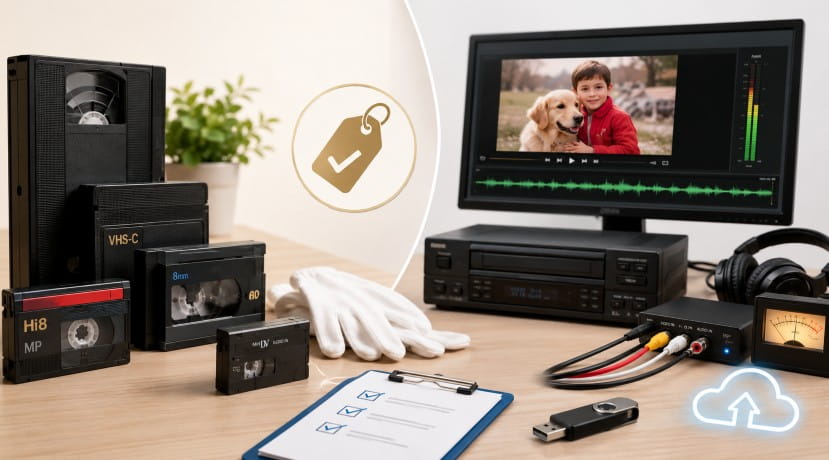
The cost of digitizing video tapes is not always as simple as the price you see advertised. Some companies advertise a low starting price, but the final cost can change once you add longer tape fees, DVD fees, USB fees, shipping, cloud access, repairs, or other extras.
When you are converting old VHS, VHS-C, Hi8, Digital8, 8mm, MiniDV, Betamax, or other video tapes, the cheapest option is not always the best value. These tapes may contain family memories, weddings, birthdays, vacations, school events, business footage, or recordings that cannot be replaced.
Before choosing a tape transfer company, it is important to understand what you are really paying for.
Why Tape Transfer Pricing Can Be Confusing
Many tape digitizing companies do not price their services the same way.
Some charge per tape. Some charge based on the length of the tape. Some charge extra for tapes longer than two hours. Some charge extra for USB drives, DVDs, cloud delivery, repairs, file downloads, rush service, or special handling.
This can make it hard to compare companies because the advertised price may not be the final price.
A company may look cheaper at first, but the total cost can increase once the order is actually processed.
Long Tape Fees Can Add Up
One of the most common hidden costs in tape digitizing is the long tape fee.
Some companies charge one price for a standard tape, then add extra fees if the recording is longer than a certain amount of time. For example, a company may advertise a low per-tape price but charge extra if the tape is three, four, five, or six hours long.
That means a customer with several long VHS tapes may end up paying much more than expected.
At Quick Digitals, our standard video tape transfer price is $20 per tape. We do not charge extra just because a tape is longer.
If your tape is two hours, four hours, or six hours, the standard transfer price is still $20 per tape.
Cheap Transfers Can Sometimes Produce Poor Results
Price matters, but quality matters too.
Old video tapes do not always play perfectly. A tape may have tracking problems, weak audio, jumpy video, mold, heat damage, humidity damage, tape wear, or other issues caused by age and storage conditions.
If a company rushes every tape through the same equipment without checking the result carefully, the customer may receive a poor-quality transfer even though the tape could have played better on different equipment.
Common quality problems include:
- Jumpy video
- Tracking lines
- Weak or missing audio
- Distorted colors
- Unstable playback
- Over-compressed digital files
- Parts of the tape being missed
Sometimes the tape itself is badly damaged and there are limits to what can be recovered. But sometimes the first playback result is not the best result the tape can give.
Multi-Cycle Conversions Are Included Free
As video tapes age, they can play differently on different equipment. One tape may look bad on one machine but play better on another. Another tape may have better audio, less jumping, or more stable playback on a different setup.
At Quick Digitals, we call this process multi-cycle conversion.
When needed and when possible, we test tapes on different playback equipment to find the best available video and audio result before digitizing. We do not simply accept a bad result from the first machine and send it to the customer.
Multi-cycle conversions are included at no additional charge when needed.
This is one of the biggest differences between careful in-house digitizing and rushed tape transfers.
Stereo Audio Help Is Included When Possible
Some old tapes lose audio on the left or right channel. Sometimes one side is weak, missing, or unstable. If the audio is not checked, the customer may receive a transfer where the sound only comes from one speaker or one side of the file.
At Quick Digitals, we review the audio and video before completing the order. When possible, we help create a more usable stereo audio result so the file plays better for the customer.
This is included at no additional charge when applicable.
Audio problems are easy to miss if a company is only focused on fast, low-cost transfers. But for family memories, voices, speeches, music, and home videos, the sound matters too.
In-House Digitizing Matters
Another thing to consider is whether the company actually digitizes your tapes themselves.
Some businesses accept tape orders but send them somewhere else for conversion. This can create extra handling, extra transportation, longer turnaround times, and less control over the process.
The customer may not always know who actually handled the tapes.
At Quick Digitals, we digitize tapes in-house. Your tapes are handled by us and are not sent to an unknown third-party company for processing.
In-house service gives us more control over quality, communication, turnaround time, and how each tape is handled.
The Real Cost Is Not Just the Price Per Tape
When comparing tape digitizing companies, do not only look at the lowest advertised price.
Look at the full value:
- Does the company charge extra for long tapes?
- Do they digitize in-house?
- Do they check audio and video quality?
- Do they try different equipment when a tape plays poorly?
- Do they charge extra for common quality-control steps?
- Do they handle VHS-C, Hi8, Digital8, 8mm, MiniDV, Betamax, and other formats?
- Do they clearly explain the final cost?
A cheap transfer is not a good deal if the result is poor, the audio is bad, the tape was rushed, or the final price ends up higher than expected.
What Quick Digitals Includes
Quick Digitals keeps pricing simple and focuses on careful in-house service.
Our standard video tape transfer includes:
- $20 flat-rate pricing per tape
- No extra charge for longer tapes
- Free multi-cycle conversions when needed
- Free stereo audio help when possible
- In-house digitizing
- Options for USB, cloud download, or DVD
- Support for many tape formats
We digitize formats such as VHS, VHS-C, Hi8, Digital8, 8mm, MiniDV, Betamax, camcorder tapes, and audio cassettes.
If a tape needs repair, such as splicing a ripped or broken tape, that may have a separate repair fee. But for standard tape transfers, we do not add extra charges just because the tape is long or needs normal playback testing.
Why Experience Matters
Old tapes can be unpredictable. Two tapes from the same box may not play the same way. One may have perfect audio but jumpy video. Another may have weak audio but a stable picture. Another may play poorly on one machine and better on another.
Since 2014, Quick Digitals has helped customers preserve thousands of old tapes, camcorder videos, and family memories through careful digitizing.
That experience matters because tape transfer is not always a simple push-button process. The equipment, playback method, audio check, file quality, and handling process can all affect the final result.
Local Drop-Off and Nationwide Mail-In Service
Quick Digitals offers local drop-off for customers near Glendale, Burbank, Pasadena, Los Angeles, and surrounding Southern California areas.
For customers outside the area, nationwide mail-in service is also available.
Whether you are converting one tape or a large family collection, we can help transfer your old videos to digital files so they are easier to watch, save, share, and back up.
Choose Value, Not Just the Lowest Price
The true cost of digitizing video tapes is not just the advertised price. It is the quality of the transfer, the care given to your tapes, the extra fees you may or may not be charged, and the confidence that your memories are being handled properly.
If your tapes contain memories you care about, it is worth choosing a service that takes the time to handle them carefully.
Quick Digitals can help convert your old tapes to digital files with simple pricing, careful in-house digitizing, and no extra charge for longer tapes, multi-cycle conversions, or stereo audio help when applicable. Click here to get started.