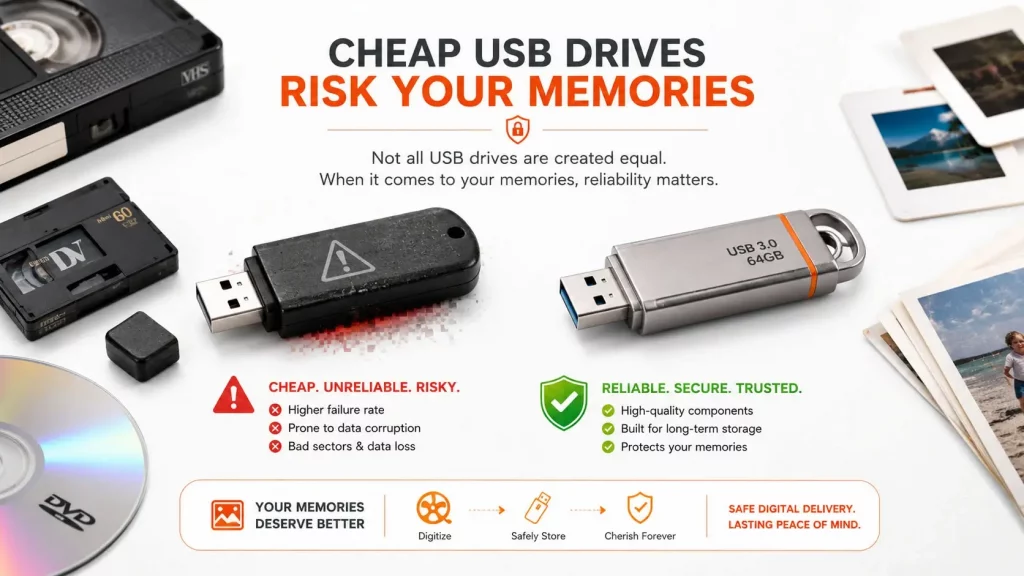
When people digitize their old video tapes, they usually focus on the tape itself. VHS, VHS-C, Hi8, Digital8, 8mm, MiniDV, Betamax, and other older formats often contain memories that cannot be replaced. But there is another important part of the digitizing process that many people do not think about: The USB drive your digital files are saved on. Recently, we learned that some local competitors and even some larger tape digitizing companies may place customers’ finished video files on cheap, non-branded USB drives. That may sound harmless at first. A USB drive is a USB drive, right? Not always. When your family memories are being digitized, the quality of the USB drive matters. A cheap storage device can become the weakest part of the entire process.
Why Cheap USB Drives Are a Problem
Cheap, non-branded USB drives are often made with lower-quality components. Some may work at first but fail later. Others may have problems right out of the box. The biggest issue is reliability. If a USB drive fails, becomes unreadable, or corrupts the files stored on it, the digital copy of your memories may be lost. That is a serious problem when the files are old family videos, weddings, birthdays, graduations, vacations, childhood memories, or footage of loved ones who may no longer be here. A low-quality USB drive can cause problems such as:- Drive failure.
- Corrupted video files.
- Files that disappear or cannot be opened.
- Bad sectors on the drive.
- Transfer errors.
- Less usable storage than advertised.
- Videos that freeze, skip, or fail to copy properly.
Some Cheap USB Drives Have Bad Sectors Right Out of the Box
One of the major problems with cheap USB drives is that some can have bad sectors before they are ever used. A bad sector is a damaged or unreliable part of the storage device. If video files are saved to that area, the file may become corrupted or unreadable. This can be especially risky with digitized video files because video files are usually large. A single tape can create a large file, and if that file lands on a bad part of the drive, the customer may not discover the problem until later. In some cases, the USB drive may say it has a certain amount of storage, but the full capacity is not actually reliable or usable. That means a customer may think their memories are safely stored, but the drive may already be unstable.Your Digital Files Are Only as Safe as the Drive They Are Stored On
Digitizing a tape is only part of the job. The final digital files also need to be delivered on a reliable storage device. If a company carefully transfers a tape but then saves the finished files onto a poor-quality USB drive, the customer is still at risk. A cheap USB drive can fail without warning. It may work once, then stop being recognized by a computer. It may show folders but not open files. It may copy slowly, disconnect randomly, or corrupt large video files. For everyday documents, that would already be frustrating. For family memories, it can be heartbreaking. That is why the storage device should be treated as part of the quality process.Large Video Files Need Reliable Storage
Digitized tapes can create large video files. Depending on the length of the tape and the file format, one tape can take up a lot of space. Cheap USB drives often struggle more with larger files. Some may appear to work with small photos or documents but become unreliable when handling large video files. This can lead to problems such as:- Slow copying.
- Failed transfers.
- Videos that do not play properly.
- Files that become damaged after copying.
- USB drives that stop responding during use.
Why Quick Digitals Uses Branded USB Drives
At Quick Digitals, we do not believe in cutting corners with your memories. That is why we use high-quality branded USB drives, including trusted brands like SanDisk, for customers who choose USB delivery. We use branded USB drives because they are generally better built, more reliable, and more appropriate for storing important video files. A good USB drive does not just look nicer. It gives customers a better storage option for the memories we worked hard to digitize. When we hand a customer their finished files, we want them to feel confident that their videos are being delivered on a dependable device.The Cheapest Option Is Not Always the Best Option
Some companies may use cheap USB drives to keep costs low. From a business point of view, that may save money. But from the customer’s point of view, it can create unnecessary risk. A customer may not know the difference between a quality USB drive and a cheap generic one until something goes wrong. By then, the files may already be corrupted or lost. At Quick Digitals, we believe the better approach is to use reliable storage from the beginning. Your memories should not depend on the cheapest USB drive available in bulk.What Customers Should Ask Before Choosing a Tape Transfer Service
If you are choosing a company to digitize your old tapes, it is worth asking how your files will be delivered. Good questions to ask include:- What kind of USB drive do you use?
- Is it a branded USB drive or a generic one?
- Are the files checked after being copied?
- Are my tapes digitized in-house?
- Do you offer cloud download or backup options?
- What happens if the USB drive fails?